
VIP member

Trace element detection instrument for soil
Principle of trace element detection instrument in soil: When using a certain leaching agent to leach soil, fertilizer or crop plants, effective nutri
Product details
Trace element detection instrument for soilPrinciple: When using a certain leaching agent to leach soil, fertilizer, or crop plants, effective nutrients enter the solution. The nutrients in the solution can react with specific colorants to generate colored substances that make the solution appear colored. The depth of the solution color is positively correlated with the nutrient content and follows the Lambert Beer law. It can be independently measured in villages and towns, or quickly measured in laboratories, and the test results can be directly printed for scientific formula fertilization guidance.
Features:
Characteristics of soil and fertilizer nutrient detection instruments for the entire project:
1. It can detect the content of available nitrogen, available phosphorus, available potassium, total nitrogen, total phosphorus, total potassium, organic matter, acidity and alkalinity, salt content, as well as various trace elements such as calcium, magnesium, sulfur, iron, manganese, boron, zinc, copper, chlorine, and silicon in soil, fertilizers, organic fertilizers (including foliar fertilizers, water-soluble fertilizers, and spray fertilizers), plants.
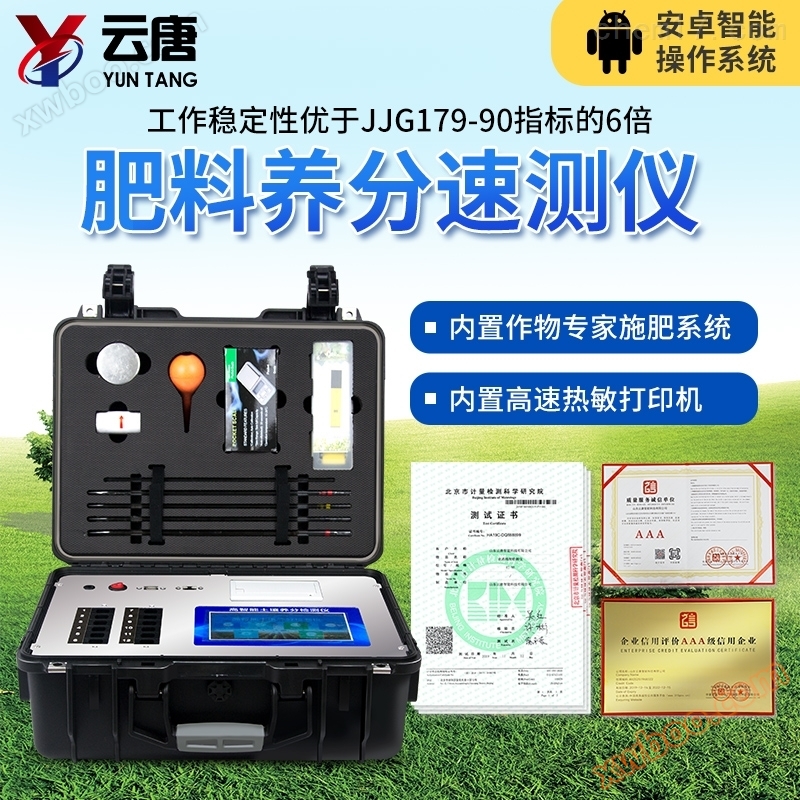
2. The Android intelligent operating system adopts more efficient and user-friendly operation. The instrument is equipped with WiFi network upload, 4G network transmission, GPRS wireless remote transmission, and can quickly upload data.
3. The built-in crop expert fertilization system can calculate recommended fertilization amounts for over a hundred national agricultural, fruit tree, and economic crops based on their target yields, and scientifically guide agricultural production according to fertilization formulas.
4. Adopting a dual row multi-channel design, it can quickly detect 12 samples at once, and all detection items can be detected simultaneously in all channels, greatly improving detection efficiency and reducing detection costs.
5. Built in plant nutrition diagnostic standard map, based on images of nutrient deficiency in various crops, conduct leaf comparison to diagnose abundance and deficiency.
6. The colorimetric groove adopts a standard 1cm colorimetric dish, with no mechanical displacement or wear. The optical path testing positioning is precise, effectively shielding external light interference and ensuring that the detection results are better than the national standard requirements.
7Trace element detection instrument for soil'
Online inquiry
-
Contacts
-
Company
-
Telephone
-
Email
-
WeChat
-
Verification Code
-
Message Content
-