
VIP member

Top mounted magnetic float level gauge
Function and Scope of Application: The SYC-UHZ-15/D series top mounted magnetic float level gauge uses a float component and measuring element to move
Product details
Function and Scope of Application
The SYC-UHZ-15/D series top mounted magnetic floating ball level gauge is composed of a floating ball component and a measuring element. Through the buoyancy effect of liquid, the floating ball moves up and down, driving the magnetic steel at the upper end of the top rod to change up and down. Through magnetic coupling, it can track the liquid level changes by flipping the magnetic column in the display component. Therefore, the display is eye-catching and the reading is intuitive. Due to the safe isolation between the display component and the measured medium, it is safe and reliable to use.
This level gauge is suitable for displaying the liquid level of various underground tanks and containers, as well as containers that are not suitable for measuring surface openings. If equipped with supporting instruments, it can be used for remote detection to achieve automatic control.
Working principle and characteristics
working principle
According to the principle of buoyancy and magnetic coupling, it is made to drive a floating ball when the liquid level in the measured container changes up and down. It moves up and down through the magnetic steel at the upper end of the connecting rod connected to it, and through magnetic coupling, the magnetic flip column in the display is flipped. The liquid level rises to red, and the liquid level falls from red to white. The red and white boundary is the actual height of the liquid level in the container, thus achieving automatic tracking and display of the liquid level.
feature
In places where the container is not suitable for measuring surface openings and there is limited space around the container, this type of liquid level gauge can be installed on the upper and lower parts of the container
Suitable for liquid media with high viscosity
Various underground trenches and spherical containers
Other features are the same as SYC-UHZ-15/C
Structure and external dimensions (Figure 5)
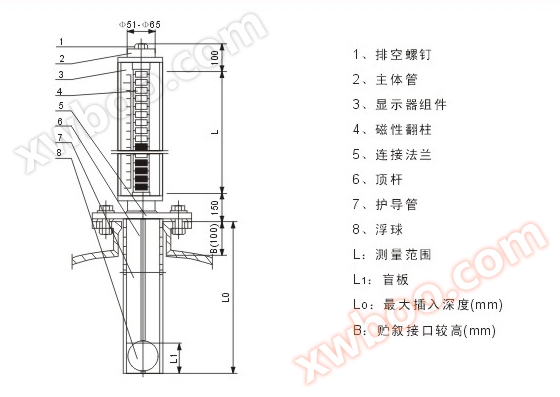
SYC-VHZ-15/D1Main technical indicators (basic type)
Selection Notice
Installation, use, and maintenance
Ordering Instructions
structural form

The SYC-UHZ-15/D series top mounted magnetic floating ball level gauge is composed of a floating ball component and a measuring element. Through the buoyancy effect of liquid, the floating ball moves up and down, driving the magnetic steel at the upper end of the top rod to change up and down. Through magnetic coupling, it can track the liquid level changes by flipping the magnetic column in the display component. Therefore, the display is eye-catching and the reading is intuitive. Due to the safe isolation between the display component and the measured medium, it is safe and reliable to use.
This level gauge is suitable for displaying the liquid level of various underground tanks and containers, as well as containers that are not suitable for measuring surface openings. If equipped with supporting instruments, it can be used for remote detection to achieve automatic control.
Working principle and characteristics
working principle
According to the principle of buoyancy and magnetic coupling, it is made to drive a floating ball when the liquid level in the measured container changes up and down. It moves up and down through the magnetic steel at the upper end of the connecting rod connected to it, and through magnetic coupling, the magnetic flip column in the display is flipped. The liquid level rises to red, and the liquid level falls from red to white. The red and white boundary is the actual height of the liquid level in the container, thus achieving automatic tracking and display of the liquid level.
feature
In places where the container is not suitable for measuring surface openings and there is limited space around the container, this type of liquid level gauge can be installed on the upper and lower parts of the container
Suitable for liquid media with high viscosity
Various underground trenches and spherical containers
Other features are the same as SYC-UHZ-15/C
Structure and external dimensions (Figure 5)
SYC-VHZ-15/D1Main technical indicators (basic type)
- Applicable media: alkali, concentrated sulfuric acid, benzene, water, light oil, etc.
- Measurement range: 0~800mm-4000mm
- Measurement accuracy: ± 10mm
- Work pressure: -0.1Mpa~2.5Mpa
- Working temperature: -15~420 ℃
- Medium density: ≥ 0.5g/cm3
- Medium viscosity: ≤ 0.02pa. s (at normal operating temperature)
- Connection flange standard: HG20592~20635-97. If the user uses other standards (such as GB, JB, JIS, ANSI, etc.), please specify them when ordering.
- Notes:
- There is a certain blind spot in the measurement of this liquid level gauge, so the zero position scale of the scale has been adjusted accordingly when it leaves the factory.
- Please make sure to indicate L0 and L when placing an order
Selection Notice
- Anti corrosion type nominal pressure ≤ 1.0MPa
- There is a certain blind spot in the liquid level gauge, so compensation for the blind spot value should be added when reading the liquid level height (when our liquid level gauge leaves the factory, the zero position of the scale has been moved to the actual value).
- The measuring range of the liquid level gauge should not exceed 5 meters, otherwise it will affect the stability, reliability, and firmness of the liquid level gauge.
Installation, use, and maintenance
- The protective tube and main tube of the liquid level gauge must be kept vertical
- The top pole cannot bend and must be inserted straight.
- After installation, the flip column of the monitor needs to be guided by magnetic steel to display red when pressed once above zero position and white when pressed below zero position.
- The structural form is shown in Figure 6.
Ordering Instructions
- Model specifications, supporting instruments
- measurement range
- Maximum insertion depth
- Media name and density
- work pressure
- Operating Temperature
- Material requirements
- Flange standards and connection forms
structural form
Online inquiry
-
Contacts
-
Company
-
Telephone
-
Email
-
WeChat
-
Verification Code
-
Message Content
-