
VIP member
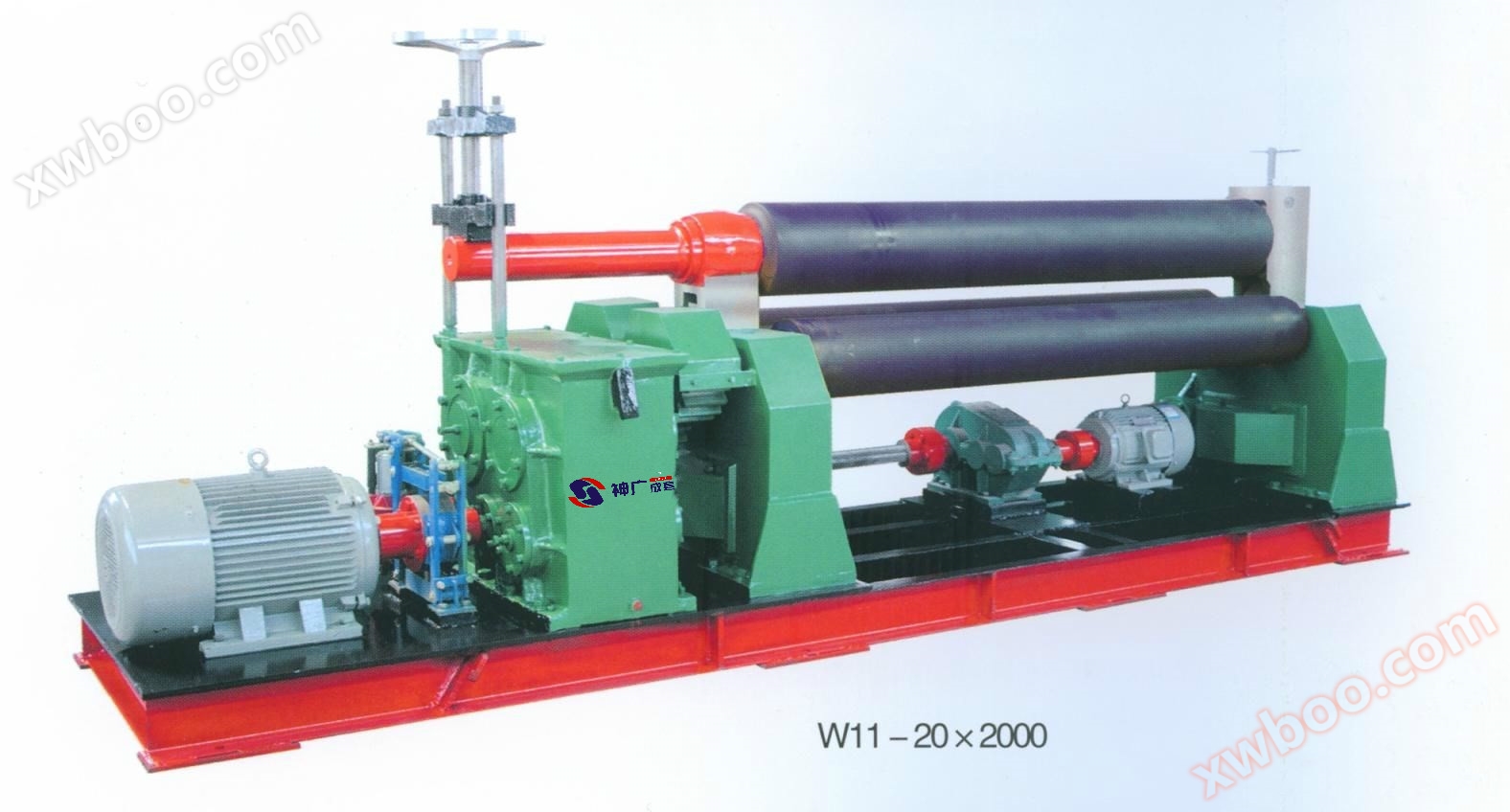
Symmetrical Three Roll Plate Rolling Machine
Introduction - The bending method of the straight edge of the drum of Chengdu symmetrical three roll plate rolling machine? The symmetrical three roll
Product details
What is the bending method for the straight edge of the drum of Chengdu symmetrical three roll plate rolling machine?
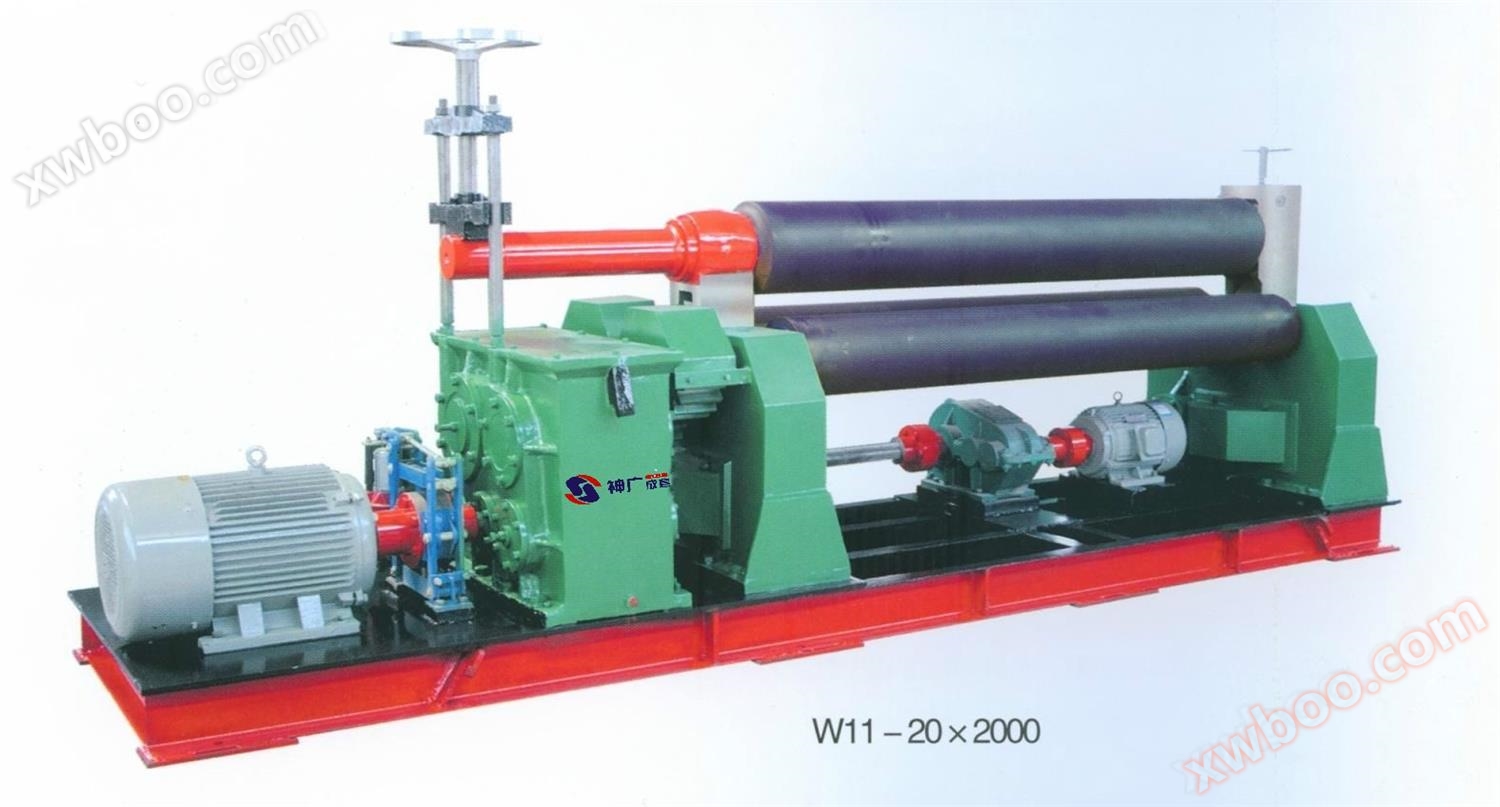
The symmetrical three roll plate rolling machine is a commonly used plate rolling machine in practice, and its rolling principle is shown in Figure 1. The upper roller is a passive roller that can move up and down; The lower roller is an active roller and a fixed roller. When the sheet is fed between the upper and lower rollers, the lower surface of the steel plate comes into contact with the high points of the two rollers. When the upper roller presses down and exceeds the yield limit of the material, the sheet undergoes plastic deformation. As the three rollers rotate, an arc is formed, and the outer fibers of this arc are stretched, the inner layer is squeezed, and the neutral layer remains unchanged. At this point, the steel plate is rolled into a circle. Due to the symmetrical three rollers of the bending machine, the force on the plate is relatively uniform before and after the bending process, which can effectively solve the problems of steel plate rebound and accuracy. Its disadvantage is that the symmetrical bending machine cannot bend the entire length of the sheet, and the two ends of the sheet are still straight with a length approximately equal to half of the distance between the centers of the lower rollers. To bend the straight edge, a press can be used for pre bending or a pallet can be used for pre bending inside the bending machine (as shown in Figure 2). However, this method requires the use of auxiliary tools such as molds or pallets, and the auxiliary tools for processing different cylinders are also different, resulting in higher rolling costs and lower productivity for this method. Another method is to keep the straight edges during rolling and then process them after the rolling is completed. Obviously, this method will also increase the rolling cost and lower the rolling productivity.
A new method of bending straight edges with two bends
In order to overcome the shortcomings of traditional bending and straight edge methods, this paper studies and adopts a new method. When using this method, the tube rolling process is divided into two steps, as follows.
2.1 One roll production
Leave the straight edges of the bent coil untreated, bend the steel plate into two simplified shapes as shown in Figure 3, and then weld them together at the interfaces at both ends of the steel plate to form a whole. The important thing in this rolling process is to ensure that the two ends of the steel plate can be smoothly closed after bending, so it is necessary to choose a reasonable simplified radius ruler for each bending. The determination is determined by the geometric relationship in the circumferential direction of the cylinder, and the specific determination method is as follows:
Firstly, the cylinder shown in Figure 3 (a). In order to ensure that the two ends of the steel plate can be smoothly closed after bending, the length of the neutral layer of the cylinder, namely the loop ABmC, should be equal to the length of the steel plate, that is, equation (1) is a transcendental equation, and the solution can determine the radius of the neutral layer of the simplified circular arc segment. Then, the upper roller downward pressure can be calculated from R ', and the cylinder can be bent.
Secondly, the cylinder shown in Figure 3 (b). The formation of the cylinder requires first rolling it into a simplified shape as shown in Figure 3 (a), and then using a press or manual rolling to form the shape shown in Figure 3 (b). The advantage of this simplified Chinese character is that it is relatively easy to roll for the second time because there is no sharp point at point A of the simplified Chinese character shown in Figure 3 (a). Compared with the cylinder shown in Figure 3 (a) during rolling, the only difference is the radius. Simply change equation (1) to equation (2), and the rest will be the same. 2.2 Second Rolling
Roll the semi-finished cylinder shown in the figure into a simplified finished cylinder with a diameter of D. When rolling, the downward pressure of the upper roller is calculated based on the diameter D, but it must be considered that the steel plate material will harden after one roll, and the actual yield limit of the material will increase compared to before rolling.
3 Conclusion
(1) In actual rolling of simplified Chinese characters, due to inaccurate calculation of the upper roller pressure and changes in material characteristic parameters, the cylinder needs to be rolled multiple times to achieve the final size, so this method will not reduce processing efficiency. As there is no need to separately bend straight edges, the processing efficiency will actually be improved. Meanwhile, as there is no need to use templates or drag plates, the cost is also reduced.
(2) This method does not require the use of auxiliary equipment or tools, so it is simple, easy to implement, and easy to popularize.
(3) It is crucial to accurately calculate the radius of a rolled cylinder and the corresponding amount of upper roller pressure. The transcendental equation shown in equation (1) or equation (2) can be solved using computer software. Due to its superior characteristics, this method has been applied in some enterprises.
Online inquiry
-
Contacts
-
Company
-
Telephone
-
Email
-
WeChat
-
Verification Code
-
Message Content
-