
VIP member

MDI3 iodine analyzer
MDI3 Urine Iodine Analyzer User Manual 1 Overview 1.1 Purpose: Urine Iodine Measurement
Product details
User Manual for MDI3 Urine Iodine Analyzer
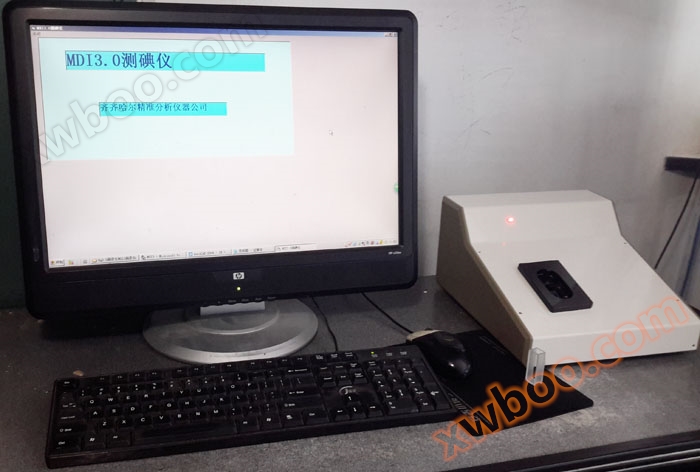
1 Overview
1.1 Purpose: Urine iodine determination. Determination of trace amounts of iodine in any sample. This instrument is designed to comply with the health industry standard WS/T107-2006 of the People's Republic of China for the determination of iodine in urine using arsenic cerium catalytic spectrophotometry.
1.2 Working principle
Urine samples are subjected to constant temperature and timed heating treatment under acidic and oxidative conditions to eliminate various interferences from organic matter. Iodine in various valence states is reduced to the form of negative monovalent iodine ions in the presence of arsenite ions, and catalyzes the oxidation-reduction reaction of arsenic cerium, causing the high valence cerium to fade and resulting in a decrease in absorbance. The logarithmic relationship between urinary iodine concentration and absorbance is linear.
1.3 Technical indicators
1.3.1 Operating Environment Temperature: Room Temperature to 40 ℃
1.3.2 Operating environment pressure: 84.0-106.7 kPa
1.3.3 Working power supply: 220VAC, 50Hz, power 5W.
1.3.4 Testing range: The testing range for iodine content in the solution is 10-250 μ g/L. Urine iodine content is determined. This method is applicable for the determination of total iodine content in urine. The measurement range is 10-250 μ g/L.
Linear error (%)<5, detection limit (ng/mL)<0.5, 15ng/L repeatability<3%
1.5ng/L repeatability<3%, optical path: iodine vapor optical path 200mm. Windows interface control.
2. Planning of Iodine Analysis Laboratory
2.1 Laboratory
The sample pretreatment room is 5 square meters, with a ventilated kitchen (or replaced with a dual hole range hood) occupying 1 square meter.
The iodine analysis room is 10 square meters, with an instrument workbench (or 2 computer desks) of 2 square meters, a workbench of 1.5 square meters, and 1 reagent cabinet (or reagent rack).
At least one person is required. The work speed is 8 hours per person per day. A work schedule can measure 100 urine samples, and two people can measure 400 urine samples.
2.2 Analytical Instruments
|
serial number |
name |
quantity |
purpose |
|
1 |
MDI3 Urine Iodine Analyzer |
1 |
measurement |
|
2 |
DTD -16 Urine Iodine Determination Digestion Instrument |
1 |
Digestive urine sample |
|
3 |
MU-2 Type Urine Iodine Measurement Super Water Bath
(30±0.2℃)
|
1 |
Provide a constant temperature environment for measuring catalytic reactions |
|
4 |
1 microcomputer
(WINDOWS95 operating system)
|
1 |
|
2.3 List of MDI3 Urine Iodine Testers
|
serial number |
name |
quantity |
|
1 |
MDI3 Urine Iodine Analyzer Host |
1 unit |
|
2 |
220V50Hz power cord |
1 piece |
|
3 |
USB line |
1 piece |
|
4 |
10mm color ratio |
2 of them |
2.4 Experimental Supplies
|
serial number |
name |
quantity |
purpose |
|
1 |
Big suction ball |
1 |
Extract solution or urine sample |
|
2 |
Small suction ball |
1 |
Extract solution or urine sample |
|
3 |
500 microliter pipette (instead of 0.5ml pipette) |
1 |
Extract urine sample |
|
4 |
20L plastic bucket |
1 |
Install distilled water |
|
5 |
25mL test tube rack with 50 holes |
2 |
Put the digestive tract in place |
|
6 |
1000W electric furnace |
1 |
Used for arsenic solution preparation |
2.5 Glass Instruments
|
serial number |
name |
quantity |
purpose |
|
1 |
Digestive tract (outer diameter 15mm x length 100mm) |
1000 |
Digestive samples |
|
2 |
Large dryer |
1 |
Save digestive tract to prevent dust contamination |
|
3 |
0.100 ml straw |
2 |
Extract standard solution |
|
4 |
0.2ml straw |
2 |
Extract standard solution |
|
5 |
0.50 ml straw |
2 |
Extract standard solution, water, and urine samples |
|
6 |
5ml pipette |
1 |
Prepare standard solution (solution B) |
|
7 |
5ml pipette |
1 |
Prepare standard solution (C solution) |
|
8 |
10 ml pipette |
1 |
Prepare standard solution (solution D) |
|
9 |
1000 ml volumetric flask |
1 |
Prepare iodine standard reserve solution (referred to as solution A) |
|
10 |
100 ml volumetric flask |
3 |
Prepare iodine standard solution (referred to as solution B, solution C, solution D) |
|
11 |
2000 ml volumetric flask |
1 |
Prepare arsenic solution |
|
121 |
1 500ml volumetric flask |
1 |
配制硫酸铈溶液 |
|
13 |
500 ml reagent bottle |
1 |
Prepare digestive agent |
|
14 |
250 ml triangular bottle |
2 |
Used for preparing reagents |
|
15 |
Glass mixing rod |
5 |
Used for preparing reagents |
|
16 |
10L lower mouth bottle |
1 |
Install distilled water |
3 reagents
3.1 The experimental water used is ordinary distilled water, which can meet the needs.
3.2 Iodine standard reserve solution (solution A): Weigh 0.1685g of potassium iodate [KIO3] baked at 110 ℃ for 2 hours, to a constant volume of 1L. 1.00 ml of this solution contains 100.0 μ g of iodine.
Alternatively, 1000 ml of iodine standard stock solution (referred to as solution A) can be prepared using iodine standard. Cut open an ampoule containing 100 mg of iodine standard to a volume of 1000 ml. Alternatively, solution A can be prepared using high-grade pure potassium iodide [KI]. Weigh 0.1308g of high-quality pure potassium iodide [KI] that has been baked at 110 ℃ for 2 hours, and dilute to a volume of 1000 ml. The iodine concentration in solution A is 100 mg/L.
3.3 Iodine standard solution (solution B): Take 5.00 ml of solution A to a constant volume of 100 ml. 1.0 ml of this solution contains 5.0 μ g of iodine.
3.4 Iodine standard solution (solution C): Take 5.00 ml of solution B to a constant volume of 100 ml. 1.0 ml of this solution contains 0.25 μ g of iodine.
3.5 Iodine Standard Solution (Solution D): Take 10.0 ml of Solution B to a constant volume of 100 ml. 1.0 ml of this solution contains 0.50 μ g of iodine.
3.6 Arsenic solution: Add 600 ml of water into a 1L volumetric flask, slowly add 30 ml of high-grade pure sulfuric acid and 20 g of high-grade pure sodium chloride, and mix well. Weigh 7g of arsenic trioxide into a 100ml beaker, add 4g of sodium hydroxide, add about 100ml of water, heat on an electric furnace, stir and dissolve, pour into a volumetric flask, and make up to volume.
3.7 Cerium sulfate solution: Weigh 8.0 g of cerium sulfate [Ce (SO4) 2 • 4H2O] into a 500 ml volumetric flask, add 400 ml of water, slowly add 50 ml of high-grade pure sulfuric acid, and make up to volume.
3.8 Digestive agent: Measure 150 ml of distilled water into a 250 ml conical flask, slowly add 70 ml of sulfuric acid, mix well, let it cool, and pour it into a 500 ml reagent bottle containing sulfuric acid. Freeze at 4 degrees Celsius for 1 hour in a refrigerator. Measure 120 ml of distilled water into a 250 ml conical flask, add 120 g of sodium chlorate, shake the flask to dissolve, and mix with dilute sulfuric acid.
4 Installation
4.1 Whole machine installation
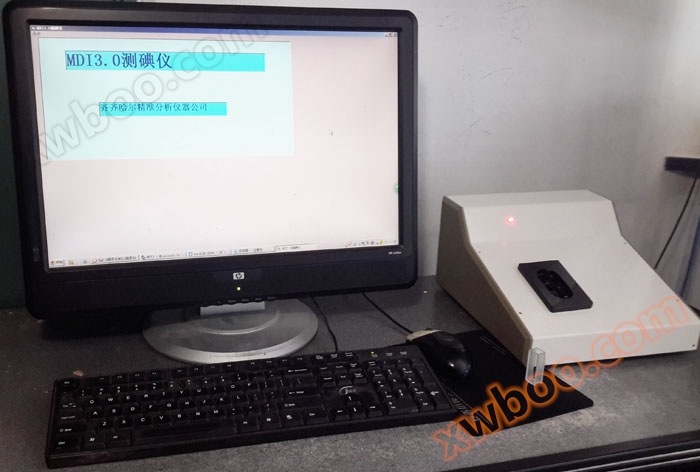
Figure 4.1 Installation diagram
4.2 Software Installation
Copy the * D drive from the MDI3 folder and double-click the icon in the MDI3 folder to install the software.In the MDI3 folderIcon sending * desktop.
4.3 Startup: Double click the MDI3 icon to enter the interface shown in Figure 3.3. Click to enter the next interface.

5 Interface Operations
5.1 Click to enter the main interface of MDI3.0 urinary iodine analyzer.
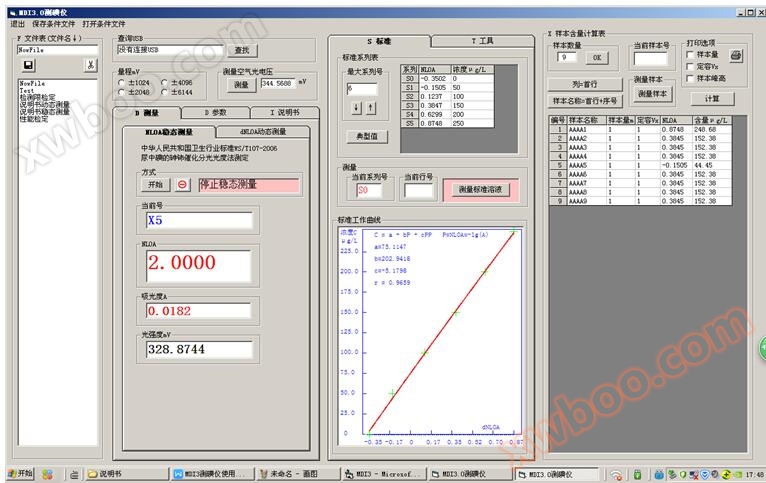
Figure 5.1.1 Main interface
When the USB port is normal, see Figure 5.1.2

Figure 5.1.2 Normal USB connection indication
5.2 Writing File Names

5.3 Set range: see Figure 5.3

5.4 Measurement of air photovoltage: see Figure 5.4. Remove the 10mm cuvette from the optical path groove and click the button in Figure 5.4. The operation of measuring air photovoltage should be carried out frequently throughout the entire operation process, relative to zeroing the instrument.
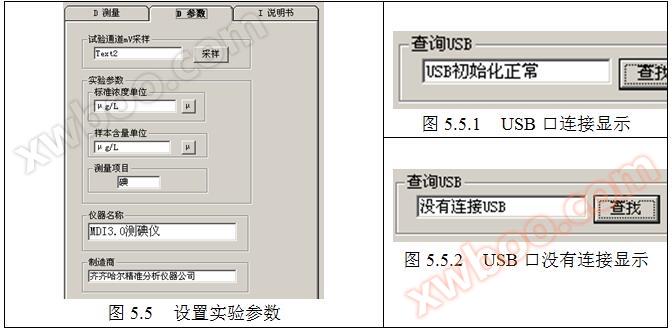
5.5 Parameter SettingsThe parameter settings are shown in Figure 5.5.
Special note: When the MDI3 host is connected to the USB port of the microcomputer, after opening the software, Figure 5.5.1 will be displayed. When the USB port of the MDI3 host is not connected to the microcomputer, after opening the software, Figure 5.5.2 will be displayed.
6 Standard Series
6.1 Instrument conditions: Turn on the urine iodine analyzer and preheat for 10 minutes.
6.2 Increase and decrease standard series * * values: see Figure 6.2.

6.3 Write standard concentration values: see Figure 6.2.
6.4 Write sample quantity: Refer to Figure 6.3. After writing the sample quantity, click the OK button.

6.5 Printing Options: As shown in Figure 6.5, select the items to be printed in the checkbox.
7 Urine sample collection
Collect 5-10 ml of random urine samples from the test population at noon using a sampling cup, and store them in a washed glass bottle of about 5ml. If the measurement cannot be completed within a week, they can be frozen and stored in the refrigerator.
8 Sample Processing
Place 8 test tubes on an aluminum test tube rack, add 0, 0.05, 0.10, 0.20, 0.30, 0.40, 0.50 ml of C solution and 0.500 ml of urine sample, add water * 0.50 ml each. Add 0.50 ml of digestive agent. Move the DTD -16 digital constant temperature digestion instrument into a ventilated kitchen and preheat it to 115 ℃. Put the test tube into the DTD-16 microcomputer constant temperature digestion instrument for digestion for 40 minutes, and then remove it. After use, remove the DTD -16 microcomputer constant temperature digestion instrument from the ventilated kitchen. Add 5.00 ml of arsenic solution to each test tube and mix well. There are no salt crystals at the bottom of the test tube. The standard iodine concentrations are 0, 2.5, 5.0, 10.0, 15.0, 20.0, and 25.0 μ g/L. Place the test tube rack together in a super constant temperature water bath at 30 ± 0.2 ℃ for about 10 minutes. Pour the cerium sulfate solution into a 20 ml test tube and also maintain a pre constant temperature in the super water bath. (Sampling volume 0.500 ml, constant volume=5ml.)
9 Steady state measurement
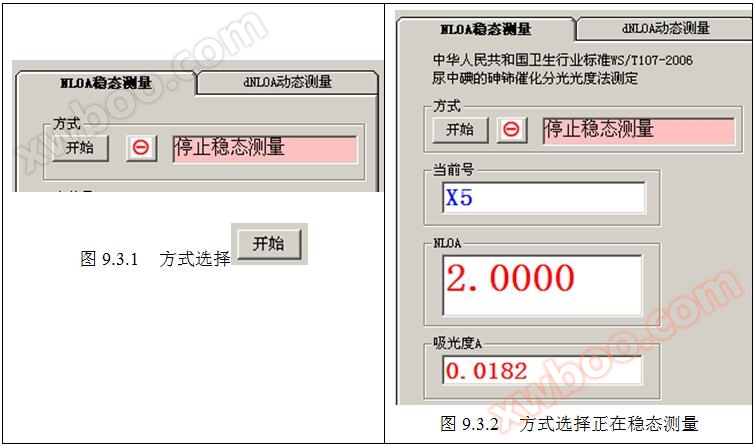
Click on the NLOA steady-state measurement card to enter steady-state measurement, as shown in Figure 9.3.2.
Starting from the sequence of standard series numbers S5, S4, S3, S2, S1, S0, add 0.500 ml cerium sulfate solution to the standard series tube, blank tube, and sample tube every 30 seconds, mix well, and immediately return to the super constant temperature water bath.
9.2 Measurement of air photovoltage: see Figure 5.4. Remove the 10mm colorimetric dish from the optical path groove and click the measurement button in Figure 5.4. The operation of measuring air photovoltage should be carried out frequently throughout the entire process, relative to zeroing the instrument.
9.3 Method selection: Refer to Figure 9.3.1. After clicking the start button in the mode box, see Figure 9.3.2.
9.4 Measurement
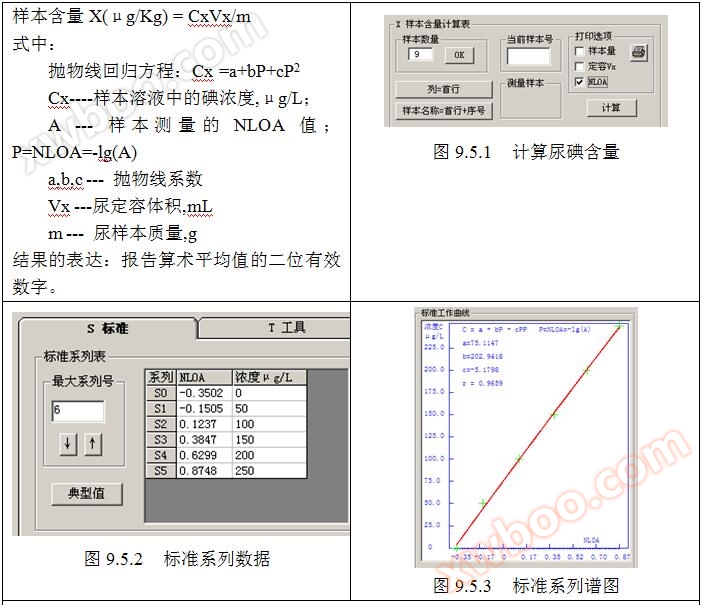
After 12 minutes (720s) of reaction in standard tube S5, start from the sequence of standard series numbers S5, S4, S3, S2, S1, S0, and measure the NLOA values of the standard tube, blank tube, and sample tube every 30 seconds. After adding the measurement solution to colorimetric four, place it on the optical path and click on the corresponding row of cells in the NLOA column, as shown in Figure 9.5.1, Figure 9.5.2, and Figure 9.5.3.
9.5 Calculate urinary iodine content: Click the calculation button in the X sample content calculation table to complete the regression analysis calculation and urinary iodine content calculation.
The urinary iodine concentration is 106.4 μ g/L, with a coefficient of variation of 2.7%. The recovery rate with a spiked value of 100 μ g/L is 98.4%.
10 Dynamic Measurement
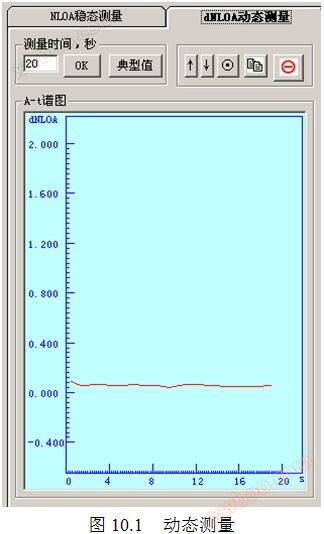
Click on the dNLOA dynamic measurement card to enter dynamic measurement. Refer to Figure 10.1.
10.1 Measurement of air photovoltage: see Figure 5.4. Remove the 10mm colorimetric dish from the optical path groove and click the measurement button in Figure 5.4. The operation of measuring air photovoltage should be carried out frequently throughout the entire process, relative to zeroing the instrument.
10.2 DNLOA values of measurement standards and samples

Starting from the standard series number S5, add 0.500 ml of cerium sulfate solution into the * S5 standard series tube, mix well, pour into the colorimetric dish, insert into the optical path, click on the dNLOA column in row S5 of the S standard table, and click on the side standard solution button in the measurement box, as shown in Figure 10.2. The dNLOA value will be automatically filled into the corresponding cell after the measurement is completed.
Add 0.500 ml of cerium sulfate solution into the * S4 standard series tube, mix well, pour into a colorimetric dish, insert into the optical path, click on the dNLOA column in row S4 of the S standard table, and click the button in the measurement box, as shown in Figure 10.2. The dNLOA value will be automatically filled into the corresponding cell after the measurement is completed.
Add 0.500 ml of cerium sulfate solution into the * S3 standard series tube, mix well, pour into a colorimetric dish, insert into the optical path, click on the dNLOA column in row S3 of the S standard table, and click the button in the measurement box, as shown in Figure 10.2. The dNLOA value will be automatically filled into the corresponding cell after the measurement is completed.
Add 0.500 ml of cerium sulfate solution into the * S2 standard series tube, mix well, pour into a colorimetric dish, insert into the optical path, click on the dNLOA column in row S2 of the S standard table, and click the button in the measurement box, as shown in Figure 10.2. The dNLOA value will be automatically filled into the corresponding cell after the measurement is completed.
Add 0.500 ml of cerium sulfate solution into the * S1 standard series tube, mix well, pour into a colorimetric dish, insert into the optical path, click on the dNLOA column in row S1 of the S standard table, and click the button in the measurement box, as shown in Figure 10.2. The dNLOA value will be automatically filled into the corresponding cell after the measurement is completed.
Add 0.500 ml of cerium sulfate solution into the * S0 standard series tube, mix well, pour into a colorimetric dish, insert into the optical path, click on the dNLOA column in row S0 of the S standard table, and click the button in the measurement box, as shown in Figure 10.2. The dNLOA value will be automatically filled into the corresponding cell after the measurement is completed.
Add 0.500 ml of cerium sulfate solution to the sample tube, mix well, pour into a colorimetric dish, insert into the optical path, click on the dNLOA column in row S4 of the S standard table, and click the button in the measurement box, as shown in Figure 10.2. The dNLOA value will be automatically filled into the corresponding cell after the measurement is completed.
10.3 Calculate urinary iodine content
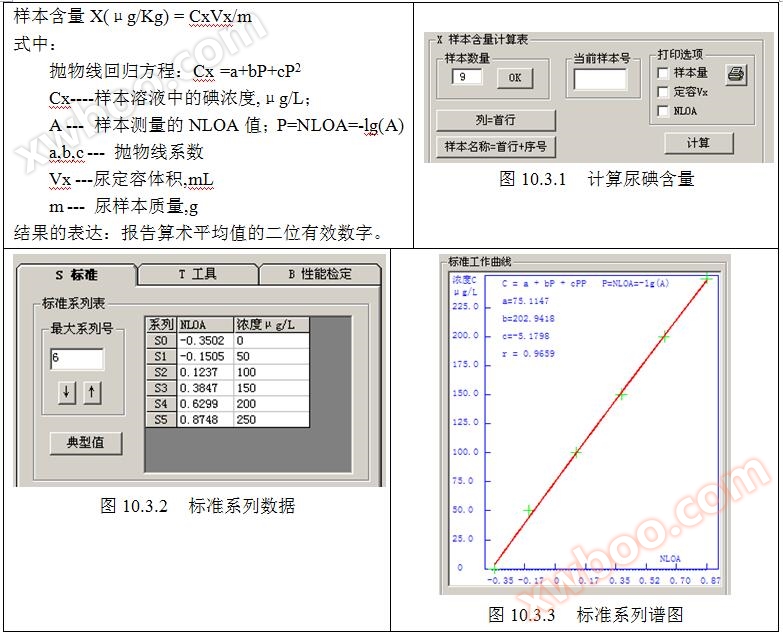
Click the calculation button in the X sample content calculation table to complete the regression analysis calculation and urinary iodine content calculation, as shown in Figure 10.3.1.
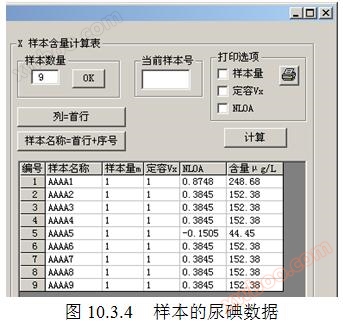
The urinary iodine concentration is 106.4 μ g/L, with a coefficient of variation of 2.7%. The recovery rate with a spiked value of 100 μ g/L is 98.4%.
Annotation on the method of constant temperature digestion for determination of urinary iodine
1. Digestion method: In the classic method, the pre-treatment of urine samples is carried out by alkaline ashing, and the measurement time is more than 20 hours. The accuracy and precision of the measured data are poor, and the measurement cost is high. Using chloric acid sulfuric acid as a digestive agent, it can be digested for 40 minutes using a DTD-16 digital constant temperature digestion instrument and used for determination. When the urinary iodine concentration is 106.4 μ g/L, the coefficient of variation is 2.7%. The recovery rate with a spiked value of 100 μ g/L is 98.4%. The presence of interfering substances accelerates the catalytic reaction and causes positive errors. The purpose of digestion is to eliminate interfering substances and the pale yellow color of the urine sample itself.
Digestive tract: Special emphasis is placed on the importance of using test tubes from the same batch, with consistent material and wall thickness to ensure the reproducibility of highly analytical results. The digestive tract should be used specifically for urinary iodine measurement. After use, rinse thoroughly, invert and dry on an aluminum test tube rack, and store in a glass dryer. Silicone particles do not need to be added to the dryer. Due to its good sealing performance and prevention of dust pollution, the dryer is an excellent equipment for storing test tubes.
3 Straws: Use 0.1.00 ml, 0.2 ml, and 0.50 ml straws to draw standard solutions. Water and urine samples can achieve high sampling accuracy and minimize sampling errors. When sampling, the standard solution and urine sample outside the straw must be wiped off with filter paper to ensure accurate sampling.
4 Blank: The iodine in the experimental blank mainly comes from various reagents in the preparation of arsenic solution. The iodine content in sulfuric acid, sodium chloride, arsenic trioxide, and sodium hydroxide is much higher than that in distilled water. Therefore, the use of distilled water has no effect on the measurement results, and even if there is an impact, it can be deducted from the working curve.
The function of chloride ions: After adding chloride ions, the concentration of chloride ions in the blank, standard, and sample is approximately the same, eliminating the interference of chloride ions in the matrix. Arsenic solution provides the reducing agent arsenic ions for catalytic reactions.
6. Dissolution of arsenic trioxide: Arsenic trioxide is easily soluble in sodium hydroxide solution and can be dissolved by alkali dissolution method.
7. Dissolution of Cerium Sulfate: Cerium sulfate is easily soluble in acidic solutions, so the acid dissolution method is used. Cerium ammonium sulfate can also be prepared.
8. Chloric acid solution: It is the most oxidizing agent with the strongest oxidizing ability. At the end of digestion, the residue is colorless and transparent. The lid of the 500 ml empty reagent bottle containing sulfuric acid is fastened onto the bottle to prevent dust contamination.
9. Ventilated kitchen: If there is no ventilated kitchen equipment, a double hole range hood can be used in the kitchen instead. Install 60cm above the digestion instrument.
10 Synchronous digestion: The standard series and urine sample are digested simultaneously, and digestion is terminated while maintaining the same digestion time.
11 The function of arsenic trioxide: After adding arsenic solution, it eliminates the oxidizing property of the residual liquid. The remaining chloric acid is converted into chloride ions. Trace iodine is in the state of iodide ions in arsenic solution.
12 Processing of high concentration urine samples: If the urine iodine concentration is greater than 250 μ g/L, the urine sample can be diluted by 1 and measured.
Spectral characteristics of cerium sulfate: The absorbance increases when the wavelength shifts to the purple. Choosing a smaller wavelength is beneficial for improving sensitivity.
Measurement sequence of the 14 standard series: Due to the absorbance of the * * standard concentration series tube (tube 1), measure the absorbance of the * * standard concentration series tube (tube 1) first.
15 Add 0.500 ml cerium sulfate solution using a 1.00 ml pipette: Add 0.500 ml cerium sulfate solution using a 1.00 ml pipette and mix quickly to prevent the solution from cooling. After adding cerium sulfate solution, the measured substance changes between two states: iodine ions and iodine molecules.
Adopting the following three methods can improve the precision of analysis
Adjust the reaction time to ensure that the absorbance of * * concentration is between 0.1 * 0.2.
Reduce the catalytic reaction temperature by 25 ℃ and increase the reaction time by 25 minutes.
16.3 Decrease in colorimetric wavelength by 405nm.
17 Digestive agents: The digestive agent proposed in this method is the strongest oxidizing agent, simplest to prepare, and most economical digestive agent provided by the author. Chloric acid is currently the strongest oxidizing agent available.
Method for determination of total iodine in table salt
This method is applicable for the determination of total iodine content in table salt. The measurement range is 1-100 mg/Kg.
Principle 1
Various valence states of iodine are reduced to the form of negative monovalent iodine ions in the presence of arsenite ions, causing a decrease in absorbance due to the fading of high valence cerium. The logarithm of iodine concentration and absorbance shows a linear relationship.
2 Prepare sample solution (E solution)
Weigh 10.00 g of salt into a 100 ml colorimetric tube, bring to volume, and dilute 10 times. (Weigh 10 g of the sample, with a constant volume of 100 ml x 10 x 5/0.5=10000 ml.)
3 Sample processing
Take 7 test tubes and place them on an aluminum test tube rack. Add 0, 0.40, 0.80, 1.20, 1.60, and 2.00 ml of C solution and 0.50 ml of E solution, respectively. Add 2.00 ml of water to each test tube. Add 3.00 ml of arsenic solution to each test tube and mix well. The standard iodine concentrations are 0, 0.020, 0.040, 0.060, 0.080, and 0.100 μ g/ml. Place the test tube rack together in a super constant temperature water bath at 30 ± 0.2 ℃ for about 10 minutes. Pour the cerium sulfate solution into a 20 ml test tube and also maintain a pre constant temperature in the super water bath.
Determination of iodine in water
This method is applicable for the determination of total iodine content in water. Measurement range: 0.5-20 μ g/L
Principle 1
Iodine in various valence states is reduced to the form of negative monovalent iodine ions in the presence of arsenite ions, causing a decrease in absorbance due to the fading of high valence cerium. The logarithm of iodine concentration and absorbance shows a linear relationship.
2 Prepare sample solution (E solution)
Weigh 10.00 g of salt into a 100 ml colorimetric tube, bring to volume, and dilute 10 times.
3 Sample processing
Take 7 test tubes and place them on an aluminum test tube rack. Add 0, 0.050, 0.100, 0.200, 0.300, 0.400 ml of C solution and 5.0 ml of water sample, and add 5.00 ml of water each. The standard iodine series concentrations are 0, 2.5, 5.0, 10.0, 15, and 20 μ g/L. Add 2.00 ml of arsenic solution to each test tube, mix well, and place it together with the test tube rack in a 30 ± 0.2 ℃ super constant temperature water bath to maintain a constant temperature for about 10 minutes. Pour cerium sulfate solution into a 20 ml test tube and also maintain a pre constant temperature in the super water bath. (Sample size 5ml, constant volume=5ml.)
Methods for determination of iodine in various foods
This method is applicable for the determination of total iodine content in food. (Content range: 200-2000 μ g/Kg)
Principle 1
Food undergoes constant temperature and timed heating treatment under acidic and oxidative conditions to eliminate various interferences from organic matter. Under the presence of various valence states of arsenic ions, they are reduced to the form of negative monovalent iodine ions, which catalyze the oxidation-reduction reaction of arsenic cerium and cause a decrease in absorbance due to the fading of high valence cerium. The logarithm of iodine concentration and absorbance shows a linear relationship.
2 Sample processing
Take 6 test tubes and place them on an aluminum test tube rack. Add 0, 10, 20, 40, 70, and 100 μ l of D solution to each tube. Take 1 test tube and place it on an aluminum test tube rack. Add 25mg of solid food or 50 μ l of liquid sample (50 μ l of soy sauce), and add 1.00 ml of digestive agent to each tube. Move the DTD -16 digital constant temperature digestion instrument into a ventilated kitchen and preheat it to 115 ℃. Put the test tube into the DTD-16 microcomputer constant temperature digestion instrument for digestion for 40 minutes, and then remove it. After use, remove the DTD -16 constant temperature digestion instrument from the ventilated kitchen. Add 5.00 ml of arsenic solution to each test tube and mix well. There are no salt crystals at the bottom of the test tube. The standard iodine concentrations are 0, 0.001, 0.002, 0.004, 0.007, and 0.010 μ g/ml. Place the test tube rack together in a super constant temperature water bath at 30 ± 0.2 ℃ for about 10 minutes. Pour the cerium sulfate solution into a 20 ml test tube and also maintain a pre constant temperature in the super water bath. (Weigh 0.025g of the sample, with a constant volume of 5ml.)
Method for determination of iodine in serum (whole blood) by constant temperature digestion
This method is applicable for the determination of total iodine content in serum. The measurement range is 50-750 μ g/L.
Serum sample collection
Collect 0.50ml of whole blood, add 0.500ml of distilled water, mix well, centrifuge to separate the serum, and draw 200 μ l of serum into the digestive tract (including 100 μ l of serum). If measuring whole blood, collect 100 μ l of whole blood into the digestive tract.
2 Sample processing
Take 6 test tubes and place them on an aluminum test tube rack. Add 0, 0.040, 0.100, 0.20, 0.300 ml of C solution and 100 μ l of serum to each test tube rack, and add 1.00 ml of digestive agent. The standard concentration of iodine is 0, 0.0020, 0.005, 0.010, 0.030 μ g/ml. Move the DTD -16 digital constant temperature digestion instrument into a ventilated kitchen and preheat it to 115 ℃. Put the test tube into the DTD-16 microcomputer constant temperature digestion instrument for digestion for 40 minutes, and then remove it. After use, remove the DTD -16 constant temperature digestion instrument from the ventilated kitchen. Add 5.00 ml of arsenic solution to each test tube, mix well, and ensure that there are no salt crystals at the bottom of the test tube. Place the test tube rack together in a 30 ± 0.2 ℃ super constant temperature water bath at a constant temperature for about 10 minutes. Pour cerium sulfate solution into a 20 ml test tube and also maintain a pre constant temperature in the super water bath. (Weigh 0.10 g of the sample, with a constant volume of 5ml.)
Online inquiry
-
Contacts
-
Company
-
Telephone
-
Email
-
WeChat
-
Verification Code
-
Message Content
-