
VIP member
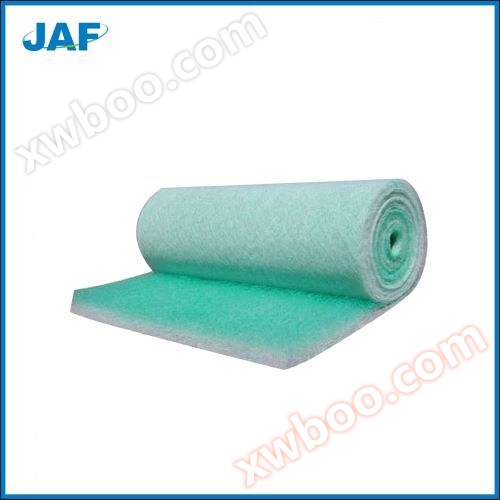
Lacquer resistant cotton
Fiberglass paint felt is made of high-quality imported fiberglass, with fine fibers arranged uniformly and orderly, gradually increasing the density o
Product details
|
Product Number |
Size (MM) |
gram weight |
efficiency |
Initial resistance |
high temperature resistance |
|
JAF-049 |
1M*20M*60MMT |
250G/㎡ |
G3 |
20pa |
≤150℃ |
|
JAF-050 |
1M*20M*100MMT |
300G/㎡ |
30pa |
||
|
Note: Special sizes and specifications can be made according to customer requirements. 2-5 times the initial resistance |
|||||
Fiberglass paint felt is made of high-quality imported fiberglass, with fine fibers arranged uniformly and orderly, gradually increasing the density of the structure. The low compression performance of the paint blocking cotton maintains its shape unchanged, making its filtering fibers completely conducive to storing oil mist and dust. During operation, the glass fiber paint barrier mesh generates static electricity by friction with compressed air, efficiently absorbing excess paint particles generated during operation and reducing environmental pollution. Using this filter can make the exhaust air more environmentally friendly and the air cleaner during internal circulation.
Product characteristics of paint blocking cotton:
1. Glass fiber with gradually increasing density of paint blocking cotton, with green/yellow on the windward side and white on the windward side
2. Lacquer resistant cotton has low compressibility, and even under heavy paint loads, it has high absorbency, especially for paint spraying under high exposure, making it economical and practical
3. The density of progressive structured optical fibers increases towards clean air, and the entire depth can be applied to dust storage
4. Obtain EN779 certification
5. Temperature resistance reaches 170 ℃
6. Roll or sheet material.
The main applications of paint blocking cotton are:
1. Paint blocking cotton is used for surface spraying, high-quality paint mist filtration, and high capture rate; Efficiently absorbing excessive free particles generated during spray painting, balancing the pressure in the workspace, it is a typical environmentally friendly material. Paint blocking cotton can trap paint mist in paint spraying rooms and equipment systems, or adsorb oil fumes in kitchens and chemical systems, to meet environmental protection requirements for emissions. Spray booth paint mist emission filtration or kitchen oil fume filtration, etc.
Online inquiry
-
Contacts
-
Company
-
Telephone
-
Email
-
WeChat
-
Verification Code
-
Message Content
-