
VIP member
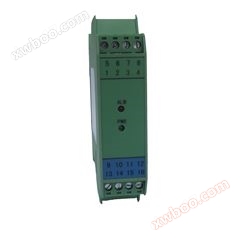
Guide rail temperature transmitter price/transmitter series
Brief description: The GD8082 thermistor signal input isolator converts the thermistor signal into a DC signal that is linearly proportional to temper
Product details
● Two wire or three wire heating resistor temperature signal input, isolated transmission output.
Intelligent, capable of on-site configuration settings. Fixed thermal leasing types and temperature range inputs can also be selected.
Modular core design, no need for zero and full adjustment, automatic dynamic calibration of zero and automatic compensation for temperature drift.
Equipped with a working power indicator light. Guide rail temperature transmitter price/transmitter series
Single channel, one input and one output, input circuit short circuit protection.
● Plug and unplug terminal block, DIN rail card installation. Guide rail temperature transmitter price/transmitter series
① The GD8082 thermistor signal input isolator converts the thermistor signal into a DC signal that is linearly proportional to temperature and outputs it to the control system or other intelligent instruments.
② Intelligent thermal resistance signal isolator. The type and range of thermal resistance can be configured and set through a computer.
③ This isolator requires independent power supply, with electromagnetic isolation between the power supply input circuit output circuit.
1、 Overview of rail type temperature transmitter:
The SBWR thermocouple temperature transmitter and SBWZ thermistor temperature transmitter are on-site installed temperature transmission units in the DDZ-S series instruments. It adopts a two-wire transmission method (two wires as power input and a common transmission line for signal output). The transmitter can be installed in the junction box of the thermocouple and thermistor to form an integrated structure by converting the thermocouple and thermistor signals into input electrical signals, measured temperatures, or linear 4-20mA output signals. As a new generation of temperature measuring instrument, it can be widely used in industrial sectors such as metallurgy, petrochemicals, power, light industry, textiles, food, national defense, and scientific research.
2、 Characteristics of rail type temperature transmitter:
1. Adopting an epoxy resin sealing structure, it is earthquake resistant, temperature resistant, and suitable for installation and use in harsh on-site environments.
2. Installed on-site in the junction box of thermal resistors and thermocouples, it directly outputs 4-20mA, which not only saves expensive compensation wire costs, but also improves the anti-interference ability during long-distance signal transmission.
3. High precision, low power consumption, wide temperature range for use, stable and reliable operation.
4. The range is adjustable and has a linearization correction function. The thermocouple temperature transmitter has a cold end automatic compensation function. Widely applicable, it can form an integrated on-site installation structure with thermocouples and thermistors, and can also be installed as a functional module in testing equipment.
3、 Main technical specifications of rail type temperature transmitter:
1. Input: Thermal resistance Pt100, Cu50, Cu100
Thermocouples K, E, S, B, T, J, N
2. Output: Within the range of measurement, outputting a 4-20mA DC signal can be linear with the output resistance signal of the resistance thermometer and linear with the input temperature signal of the resistance thermometer; It can be linear with the millivolt signal input by the thermocouple, or linear with the temperature signal input by the thermocouple thermometer.
3. Basic error: ± 0.2%, ± 0.5%
4. Transmission method: two-wire system
5. The working power supply voltage of the transmitter is 12V low and 35V high, with a rated working voltage of 24V.
6. Load: The maximum load resistance is calculated according to the following formula
RL(max)=50×(Vmm-12)
At 24V, the load resistance can be selected within the range of 0-600 Ω, with a rated load of 250 Ω.
Note: The range adjustable transmitter requires repeated debugging of zero and full scale when changing the range; The thermocouple type transmitter needs to be preheated for 30 minutes before debugging.
7. Environmental temperature impact ≤ 0.05% 1 ℃
8. Normal working environment:
a、 Environmental temperature -25 ℃~+80 ℃
b、 Relative humidity 5% to 95%
c、 Mechanical vibration f ≤ 55Hz, amplitude < 0.15mm
Online inquiry
-
Contacts
-
Company
-
Telephone
-
Email
-
WeChat
-
Verification Code
-
Message Content
-