VIP member
Product details

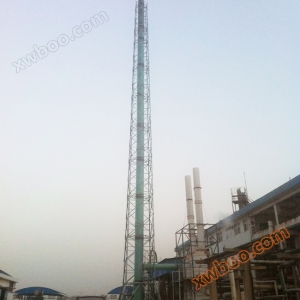
Fiberglass chimney is the main way for coal-fired waste gas emissions in industries such as thermal power and metallurgy. Taking the thermal power industry as an example, in the past, the thermal power industry often only took dust removal measures for coal-fired exhaust gas, that is, discharging the exhaust gas into the surrounding atmosphere through high chimneys. Nowadays, due to the strict control of sulfur dioxide emissions in environmental protection, it is necessary to carry out desulfurization treatment on exhaust gas. Currently, the thermal power industry mostly adopts wet desulfurization. Before adopting the wet flue gas desulfurization process, although the flue gas contains a large amount of sulfur dioxide, the temperature of the flue gas entering the chimney is relatively high, up to 130-160 ℃, and only a small amount of flue gas condensation is formed, which does not require high anti-corrosion requirements for the chimney. However, after wet desulfurization, the temperature of the flue gas drops to 50-80 ℃, and the moisture content of the flue gas is high, resulting in an increase in the corrosion concentration of the chimney inner wall. Although the flue gas temperature drops to 50-80 ℃ after wet flue gas desulfurization, it is often necessary to consider the temperature of the flue gas in emergency situations without wet flue gas desulfurization (about 150 ℃) and accident situations (nearly 200 ℃) when designing chimneys. Therefore, wet flue gas desulfurization chimneys have high requirements for corrosion resistance and temperature resistance. In order to solve the problem of severe corrosion on the inner wall of chimneys caused by the installation of wet flue gas desulfurization devices, domestic and foreign technicians have conducted extensive research and engineering experiments. At present, commonly used chimney anti-corrosion materials include acid resistant bricks acid resistant adhesive, steel titanium composite structures, steel stainless steel composite structures, steel coating materials, and hard e-276 alloy lining. Compared to others, the new type of fiberglass chimney has advantages such as corrosion resistance, low investment, short construction period, light weight, and long service life.
1、 The application of fiberglass chimney is designed, manufactured and installed reasonably, and used in the structure and complete set of equipment of wet flue gas desulfurization system. It has obvious technical, economic and social benefits, long service life, reliable operation, and has been widely used abroad. The technical and economic analysis is feasible. The use of fiberglass instead of traditional alloy steel, carbon steel lined with rubber, and carbon steel coated with resin flake resin to manufacture flue gas desulfurization devices with strong corrosion resistance, long service life, high strength, energy saving, and other advantages provides a way for the localization and cost reduction of desulfurization equipment.
2、 Comparison of advantages and disadvantages between fiberglass chimneys and chimneys made of other materials
1. Fiberglass chimney
(1) Excellent corrosion resistance, with smoke containing a considerable amount of HCL, H2SO4, and other strong chemicals, exhibiting excellent corrosion resistance
(2) Overall structure, without any corrosion or weak points
(3) High cost-effectiveness and low lifetime cost
(4) Long term maintenance free, high temperature resistance performance
(5) The product has strong designability and can be customized according to different customer needs
2. The lining of titanium (nickel) alloy composite steel plate has excellent anti-corrosion performance, and the weld area is prone to corrosion, making it expensive.
3. Steel inner cylinder
(1) Foam glass brick has strong corrosion resistance; The construction process is complex and the construction period is long
(2) Spraying anti-corrosion concrete: Poor construction conditions and complex construction processes
(3) Spraying high-performance heat-resistant and acid resistant coatings: short service life and complex maintenance
(4) The manufacturing period for acid resistant brick chimney with masonry glaze is relatively long
3、 The structural form of fiberglass chimney: 1. Concrete inner sleeve. The fiberglass chimney is mainly used for the inner cylinder of concrete chimneys with a smoke emission height of 100m-200m. In this construction, the high temperature and corrosion resistance characteristics of fiberglass are fully utilized, and concrete chimneys provide support. Some are supported by a concrete chimney with one fiberglass inner cylinder, while others are supported by two or three fiberglass inner cylinders, depending on the owner's design and requirements.
Online inquiry
-
Contacts
-
Company
-
Telephone
-
Email
-
WeChat
-
Verification Code
-
Message Content
-