
VIP member

ECLIPSE Ts2RNIKON Nikon research grade inverted microscope
The ECLIPSE Ts2R standard set of research grade inverted microscopes offers a wide range of observation methods and applications, with a compact body
Product details
NIKON research grade inverted microscopeDoing better than before
Research and configuration of various observation methods using compact inverted microscopes
ECLIPSE Ts2RThe new standard for research grade inverted microscopes provides a wide range of observation methods and applications in a compact body that can be easily installed in limited space laboratories while maintaining good operability.
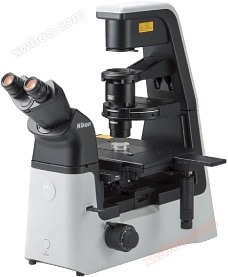

ECLIPSE Ts2R Transmission Illumination Configuration ECLIPSE Ts2R FL Transmission and Epifluorescence Illumination Configuration
NIKON research grade inverted microscope ECLIPSE Ts2R
easy to use
Simple operation
Nikon Ts2R InvertedmicroscopeThe control buttons are located in an intuitive and simplified workflow. open/Close and transmit/The fluorescence switching control is located on the front panel, and the transmission or falling fluorescence control buttons are respectively marked on the left and right sides of the microscope body.

To improve workflow, a brand new ergonomic design stage has been introduced
NIKON inverted microscope Ts2RThe height of the stage is higher than that of a standard research grade microscope*Reduced by approximately30%To ensure a comfortable hand position during repeated operations and sample exchange. And by lowering the support column and positioning the camera port on one side of the tube, the visibility of the sample is improved.
*andNikon research grade inverted microscopeECLIPSE TiCompare.

NIKON research grade inverted microscope ECLIPSE Ts2R
Selection of newly developed mechanical loading platform
Nikon inverted microscope Ts2RCan be configured with an optional rectangular mechanical stage. This stage provides a long travel distance, allowing users to observe the entire orifice plate from end to end. You can also set travel restrictions (three routes) to accommodate frequently used samples or containers. The carrier handle is available in two lengths, long or short, to further meet the needs of users.(Source: Chengguan Instrument)


useXYAdjustment of restricted travel (three-way)

High in a bright roomS / NFalling fluorescence observation
The new contrast attachment (optional) block indoor lighting provides a simple and cost-effective method for achieving high signal noise fluorescence observation in a bright laboratory.
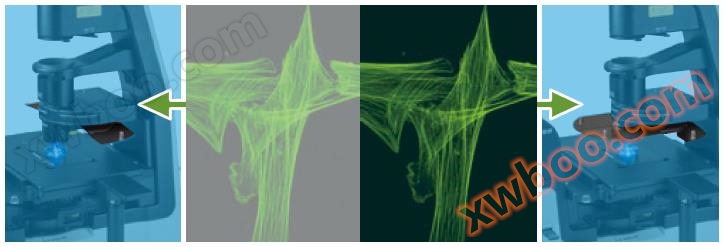
NIKON research grade inverted microscope ECLIPSE Ts2R
Multi functional observationLEDlighting lamp
high-intensityLEDThe light source can perform various observation methods similar to full-size observation,ECLIPSE TiResearch grade inverted microscope.Ts2R-FLModel, it provides fluorescence observation with four fluorescence channels and7A choice of different wavelengths.


DICEpifluorescence
Comparing new technologies, 'relief comparison'
Nikon's new comparison method is compatible with both plastic and glass culture dishes. Not like the difference orNAMCEmbossing contrast does not require a special objective lens, so it has little impact on the observation of falling fluorescence. Embossed contrast allows for easy observation of very clear and thick samples, such as embryos, in pseudo 3D images.

Picture provided by Dr. Hideaki Watanabe. Dr. Kyulong and Dr. Hasegawa
Easy to adapt to the laminar flow hood inside
At NikonTs2RThe compact size of the microscope makes it easier to store and operate inside laminar flow hoods. In addition, the position of the edge camera on the lower stage reduces user fatigue from repeated operation of the stage, and provides clear visibility of the stage and even lowers the sample with the cover grid.(Source: Chengguan Instrument)

High precision and quality
optical performance
NIKON microscope Ts2RFamous with NikonCFI60Objective lens provides a high numerical aperture and long working distance, offering stunning and clear image compatibility.
High performance and high-quality optical accessories
Optical components achieve the same performance level as Nikon research grade inverted microscopeECLIPSE TiProvide exceptionally clear and sharp images.
NIKON research grade inverted microscope ECLIPSE Ts2R
Specifications
model |
Ts2R |
Ts2R-FL |
|
optical system |
CFI60Infinite optical system |
||
Observation method |
Mingchang, apodization phase difference, phase difference, Nikon's advanced modulation comparison,DICComparison of reliefs |
Mingchang, apodization phase difference, phase difference, Nikon's advanced modulation comparison,DIC, relief contrast, falling fluorescence |
|
lighting |
Transmission lighting |
Highly luminous whiteLEDLighting fixture (energy-saving lighting) with built-in compound eye lens |
|
Falling light illumination |
(Source: Chengguan Instrument) | LEDLighting fixture with built-in compound eye lens, capable of working with up to4A different fluorescenceLEDunit configuration;Available wavelengths:385,455,470,505,525,590,625 nm |
|
observing tube |
·Binocular tube: Tilt angle:35degree ·Ergonomic tube: Tilt angle:15-35degree Hinge type, pupil distance:50-75mm |
||
Eyepiece(F.O.V.) |
10x (22), 12.5x (16), 15x (14.5) |
||
focusing |
Up through the objective lens converter/Downward movement, stroke (manual): Up8mmBelow3mm Coarse: per revolution5.0mmPrecision stroke: Each revolution is equal to0.1mmAdjustable coarse motion torque, installation of focusing mechanism |
||
Nosepiece |
Six hole objective lens converter, withDICPrism slot |
||
condenser |
Concentrator turntable, installed multiple times7Module: Difference,DIC,NAMSC,IMSIComparison of reliefs andNDFilter for bright field use, withELWDAny one in the spotlight,LWDSpotlight andNAMCcondenser |
||
slider |
Front centering or centeringPHSliders,10X,20X,40XObjective lens can differ in phase Relief contrast slider (eyepiece tube end slider must be installed),10x,20x,40x,60xThe objective lens can be used for relief comparison |
||
stage |
Ordinary stage, stage size260(X)x300(Y)mm Mechanical stroke of rectangular stage:114(X)x73(Y)mm XYAdjustable travel limit accept8Seed micro testing board |
||
Various clamps |
·C-S-HP35 35mm culture dish clamp ·C-S-HLP100 100mm culture dish ·C-S-HT Terasaki clip suitable for Terasaki seat and φ 65 disc ·C-S-HS slide holder for glass slides, with a diameter of 54 plates and blood cells ·C-S-HU Terasaki's plate holder, glass slide, diameter 35-65 dish, and universal blood cell holder ·C-S-HG Glass Ring Seat ·C-S-HLS ring seat set ·TC-S-HA Acrylic Rack |
||
Epitaxial fluorescence attachment |
Falling fluorescent filter turret (including main body) Filter Cube and Noise Termination Mechanism With as many as4Cube configuration of falling fluorescence filter, one position is used in bright field observation Detachable contrast (optional); LWD,LWD) |
||
size |
286 (W) ×495 (D) ×542 (H) mm |
286 (W) ×495 (D) ×542 (H) mm
|
|
Weight (approximately) |
17kg |
18kg(Source: Chengguan Instrument) |
|
rated voltage/current |
100V-240V, compared to0.65Afew |
||
Power consumption (nominal value) |
30W |
||
- (Off track aberration) is a technique used to reduce the observation of halo aberration, thanks to the lens coating of Nikon *
- Nikon Advanced Modulation Contrast is Nikon's modulation contrast observation method, which provides a similarDICObserve stereoscopic images, even on plastic food samples.
- The relief contrast is based on Nikon's observation method. It uses focused illumination, which provides a pseudo three-dimensional image for high contrast samples.
NIKON research grade inverted microscope
Outline dimension image:
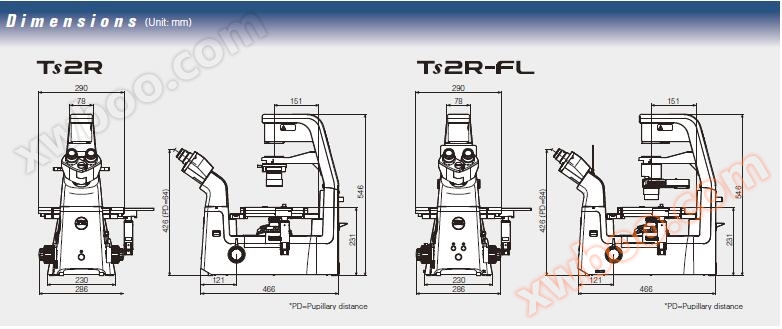
Online inquiry
-
Contacts
-
Company
-
Telephone
-
Email
-
WeChat
-
Verification Code
-
Message Content
-