
VIP member

Blast furnace dust collector
Scope of application: Detailed content of blast furnace dust removal equipment. After more than 30 years of application and development, the dry bag d
Product details
Detailed content of blast furnace dust removal equipment
After more than 30 years of application and development, the dry bag dust removal technology for blast furnace gas in China has become increasingly mature and widely used in many small and medium-sized blast furnaces. At the same time, in recent years, China has made significant progress in filter materials. The high-temperature resistant needle punched felt filter material composed of fibers and ultrafine glass fibers not only improves its strength and service life, but also increases its operating temperature, and can withstand high temperatures of about 260 degrees Celsius, laying a solid foundation for dry bag dust removal of blast furnace gas. In addition, the use of PLC automation control system enables automatic control of nitrogen pulse injection cleaning, ash unloading, and ash transportation according to the program, effectively promoting the improvement of dry bag dust removal technology for blast furnace gas.
The successful use of dry bag dust collectors in small and medium-sized blast furnaces has been adopted for large-scale blast furnacesBlast furnace dust removal equipmentEstablished the foundation. However, large blast furnaces generate a large amount of gas, and if small and medium-sized blast furnace dry dust collectors are still used, in order to achieve the same filtration efficiency, the number of casings must be doubled, resulting in an increase in the number of failure points and a significant increase in the footprint of the entire dry dust collector. Adopting this design approach reduces reliability and falls far short of meeting the needs of large blast furnaces, affecting their normal operation and causing an imbalance in energy media, resulting in significant losses.
To overcome the obstacles of dust removal equipment in large blast furnaces, our company has conducted systematic and in-depth research on dry dust removal processes, equipment, key components, ash conveying systems, etc. Through extensive argumentation, we have increased the filtration area of single box bodies, introduced large-diameter box bodies (with a diameter of 5.2 meters or more) into blast furnace gas dry dust collectors, and adopted 6-meter diameter box bodies, laying the foundation for the application and promotion of dry dust removal systems in large blast furnaces.
Dust and smoke capture in blast furnace ore tank:
The commonly used method for dust removal on the ore tank is to install a dust hood at the top of the ore bin, switch it using an electric butterfly valve, and interlock it with the process equipment. That is, when the process equipment operates, the switching butterfly valve opens synchronously, and vice versa, it closes synchronously. _This method adopts a mobile ventilation trough, which is equipped with 3 suction ports. The upper suction port captures the dust at the head of the discharge belt, and the lower suction port captures the dust at the discharge port and the mine bin. Based on usage experience, we recommend using a mobile ventilation trough.
Due to the large number of dust collection points under the mining tank and the fact that they do not work simultaneously, electric butterfly valves are used to switch between the different dust collection points, which are interlocked with the process equipment. That is, when the process equipment is working, the switching butterfly valves are synchronously opened, and vice versa, synchronously closed, reducing the system air volume and reducing power consumption.
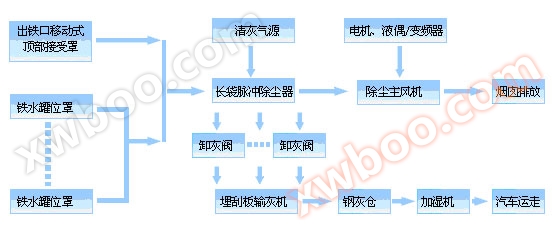
Flow Chart of Blast Furnace Dust Removal System
1. In order to facilitate system management, the main parameters of the dust removal system are measured and displayed, and necessary fault signal displays and signal alarms are set for the main equipment.
2. Merge several blast furnaces into one dust removal system, and as the tapping is intermittent, it can be switched by setting an electric wear-resistant butterfly valve. When a certain blast furnace is in operation, the corresponding butterfly valve is opened and the other butterfly valves are closed.
3. The dust removal system is controlled by a PLC machine, with differential pressure measurement of the dust collector and control of the ash conveying equipment connected to the PLC machine.
4. In order to save land, the dust removal system adopts an elevated layout, with the first floor being the fan room and dust removal control room, and the second floor being the dust collector platform.
5. In order to effectively control the large amount of smoke and dust generated by the blast furnace system, different exhaust hoods are installed at each dust point for smoke and dust capture.
6. The temperature of the flue gas in the dust removal system of the casting yard is relatively high. A mixing valve is installed on the main passage before entering the dust collector. When the flue gas temperature exceeds the set value (120 ℃), the mixing valve is opened to mix cold air into the system to ensure the safety of the dust collector.
7. Due to the high temperature of the flue gas, the quality requirements for the cleaning air source are high. The compressed air oil and water need to be separated, otherwise it is easy to cause condensation on the filter bag, affecting the cleaning effect and causing the resistance of the dust collector to greatly exceed the design resistance, ultimately leading to a significant decrease in the system air volume. Therefore, a series of processing equipment such as water separators, oil filters, pressure reducing valves, and freeze dryers are needed to treat the compressed air.
Online inquiry
-
Contacts
-
Company
-
Telephone
-
Email
-
WeChat
-
Verification Code
-
Message Content
-