
VIP member
Analysis of UWB personnel positioning cost price
UWB personnel positioning has grown rapidly in recent years, with an increasing number of application vendors and diverse application cases. Compared
Product details
The positioning of UWB personnel has grown rapidly in recent years, with an increasing number of application vendors and diverse application cases. Compared to previous years, the market has become much more competitive, and new vendors lack on-site testing environments, resulting in relatively low prices. Overall, this has lowered the price of UWB positioning. It was possible to sell a base station for 15000 yuan around 2015, but now it is obviously difficult.
Compared to other markets, the positioning market is actually relatively small because indoor positioning has always been an optional thing due to various reasons such as positioning accuracy, and previous WIFI positioning and Bluetooth positioning were no exception. This situation was not broken until the emergence of UWB technology. We say that UWB positioning is actually a cost-effective positioning method for other technologies. Compared to WIFI and Bluetooth, which have low accuracy and can only be used for navigation technology, UWB positioning embodies centimeter level high accuracy. Regarding laser positioning, a highly accurate technology, UWB demonstrates its affordability.
The cost of UWB positioning mainly includes three parts: positioning base station, positioning terminal, and positioning software. In various usage scenarios, it varies due to different specific solutions. At present, most domestic companies use the same chip, so there are some differences in algorithms, but the differences are not very significant. There are many elements that affect accuracy, and algorithms are only a part of them. In addition, on-site base station deployment methods, indoor object occlusion, and base station density all have an impact on accuracy.
In UWB positioning, the part with the largest cost change is the base station, because the demand is constant due to the correlation between the terminal and the number of users. Therefore, the total price of the terminal is only related to the unit price. If the unit price is cheap, the total price must be cheap. However, the number of base stations varies due to differences in parameters, deployment methods, and coverage areas. The total cost of base stations is related to the number and unit price of base stations. UWB positioning requires at least 3 base stations within the positioning area, usually 4. Algorithmically, if 2-point positioning is meaningless, the values will be discarded. Considering the occlusion of buildings, human bodies, etc., generally 4 base stations will be deployed in one area to increase the possibility of three-point positioning and reduce the number of invalid points.
In the process of locating base stations, the number of positioning spaces has the greatest impact on the number of base stations. Because UWB technology uses a relatively high frequency band of 6GHz, its penetration is poor. In addition, multipath effects can cause deviations in the time difference algorithm, leading to ineffective positioning. Therefore, when there is obstruction from walls or high indoor objects, it is required to increase the number of base stations in space. The simplest model is to use rooms as units, and two rooms must be considered as two positioning areas. If the shelves in the building are too high or there are many metal items, it is also necessary to distinguish the positioning intervals based on the shelves. This is also why we see all manufacturers holding UWB tags above their heads during demonstration videos, which has the best running path positioning effect. Therefore, if encountering an area with many rooms, the number of base stations needs to increase exponentially, which is also one of the reasons why UWB positioning has always been ineffective in places such as prisons. There are a huge number of prisoner rooms in the prison. For a prison with 5000 people, if all of them need to be located inside the prisoner rooms, the deployment of base stations alone would need to reach 2000. According to 8000 yuan/base station, the total cost of base stations would reach 16 million yuan. This is a project that cannot be implemented no matter what.

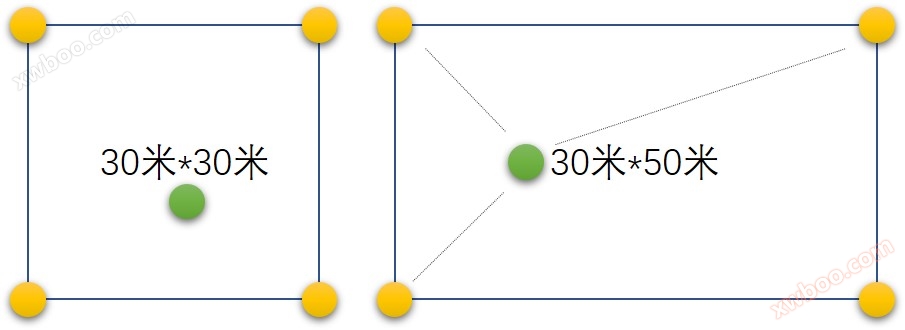
The above figure shows a typical positioning scenario, one is a square with a length and width of about 30 meters, and the other is a rectangular area with a length of about 50 meters and a width of about 30 meters, both of which deploy four base stations at the four corners, as shown by the yellow dots in the figure. The number of labels in the positioning interval can reach thousands, as shown by the green dots. For smaller areas, the number of base stations cannot be reduced, while for larger areas, the number of base stations needs to be expanded according to this ratio. Therefore, the calculation is relatively easy.
adoptTengdong PositioningThe UWB solution offers discounted prices for base stations and terminals, and the positioning software can be customized and developed for users. You can call or add WeChat for consultation.
Compared to other markets, the positioning market is actually relatively small because indoor positioning has always been an optional thing due to various reasons such as positioning accuracy, and previous WIFI positioning and Bluetooth positioning were no exception. This situation was not broken until the emergence of UWB technology. We say that UWB positioning is actually a cost-effective positioning method for other technologies. Compared to WIFI and Bluetooth, which have low accuracy and can only be used for navigation technology, UWB positioning embodies centimeter level high accuracy. Regarding laser positioning, a highly accurate technology, UWB demonstrates its affordability.
The cost of UWB positioning mainly includes three parts: positioning base station, positioning terminal, and positioning software. In various usage scenarios, it varies due to different specific solutions. At present, most domestic companies use the same chip, so there are some differences in algorithms, but the differences are not very significant. There are many elements that affect accuracy, and algorithms are only a part of them. In addition, on-site base station deployment methods, indoor object occlusion, and base station density all have an impact on accuracy.
In UWB positioning, the part with the largest cost change is the base station, because the demand is constant due to the correlation between the terminal and the number of users. Therefore, the total price of the terminal is only related to the unit price. If the unit price is cheap, the total price must be cheap. However, the number of base stations varies due to differences in parameters, deployment methods, and coverage areas. The total cost of base stations is related to the number and unit price of base stations. UWB positioning requires at least 3 base stations within the positioning area, usually 4. Algorithmically, if 2-point positioning is meaningless, the values will be discarded. Considering the occlusion of buildings, human bodies, etc., generally 4 base stations will be deployed in one area to increase the possibility of three-point positioning and reduce the number of invalid points.
In the process of locating base stations, the number of positioning spaces has the greatest impact on the number of base stations. Because UWB technology uses a relatively high frequency band of 6GHz, its penetration is poor. In addition, multipath effects can cause deviations in the time difference algorithm, leading to ineffective positioning. Therefore, when there is obstruction from walls or high indoor objects, it is required to increase the number of base stations in space. The simplest model is to use rooms as units, and two rooms must be considered as two positioning areas. If the shelves in the building are too high or there are many metal items, it is also necessary to distinguish the positioning intervals based on the shelves. This is also why we see all manufacturers holding UWB tags above their heads during demonstration videos, which has the best running path positioning effect. Therefore, if encountering an area with many rooms, the number of base stations needs to increase exponentially, which is also one of the reasons why UWB positioning has always been ineffective in places such as prisons. There are a huge number of prisoner rooms in the prison. For a prison with 5000 people, if all of them need to be located inside the prisoner rooms, the deployment of base stations alone would need to reach 2000. According to 8000 yuan/base station, the total cost of base stations would reach 16 million yuan. This is a project that cannot be implemented no matter what.
The above figure shows a typical positioning scenario, one is a square with a length and width of about 30 meters, and the other is a rectangular area with a length of about 50 meters and a width of about 30 meters, both of which deploy four base stations at the four corners, as shown by the yellow dots in the figure. The number of labels in the positioning interval can reach thousands, as shown by the green dots. For smaller areas, the number of base stations cannot be reduced, while for larger areas, the number of base stations needs to be expanded according to this ratio. Therefore, the calculation is relatively easy.
adoptTengdong PositioningThe UWB solution offers discounted prices for base stations and terminals, and the positioning software can be customized and developed for users. You can call or add WeChat for consultation.
Online inquiry
-
Contacts
-
Company
-
Telephone
-
Email
-
WeChat
-
Verification Code
-
Message Content
-