
VIP member
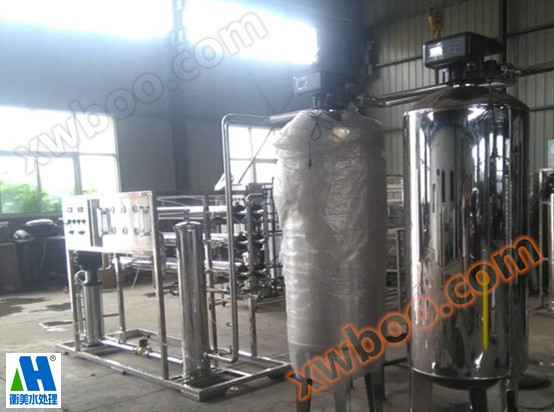
304 stainless steel single-stage reverse osmosis equipment
304 stainless steel single-stage reverse osmosis equipment
Product details
This product is made of food grade 304 stainless steel, all of which are made of stainless steel. It can be widely used in enterprises such as liquor and beverage production.
Reverse osmosis equipment, also known as pure water sampling equipment
Deionization equipment, reverse osmosis is divided into single-stage reverse osmosis and two-stage reverse osmosis equipment, some of which are also called first stage reverse osmosis and second stage reverse osmosis,
But no matter how people call it, its working principle remains the same: a thin film that selectively allows substances to pass through is called a semi permeable membrane, and a thin film that can only pass through solvents but not solutes is generally called an ideal semi permeable membrane.
When dilute solutions (such as fresh water) and concentrated solutions (such as saltwater) of the same volume are placed on both sides of a semi permeable membrane, the solvent in the dilute solution will naturally pass through the semi permeable membrane and flow spontaneously towards the concentrated solution side. This phenomenon is called permeation.
When the permeation reaches equilibrium, the liquid level on the concentrated solution side will be higher than that of the dilute solution by a certain height, forming a pressure difference, which is the osmotic pressure. The magnitude of osmotic pressure depends on the inherent properties of the solution,
It is related to the type, concentration, and temperature of the concentrated solution, but not to the properties of the semi permeable membrane. If a pressure greater than the osmotic pressure is applied to the concentrated solution side, the flow direction of the solvent will be opposite to the original osmotic direction,
The process of starting to flow from a concentrated solution to a dilute solution is called reverse osmosis. Reverse osmosis is a reverse migration movement of infiltration, driven by pressure,
The method of separating solutes and solvents in a solution by using the selective retention effect of a semi permeable membrane has been widely used in the purification and concentration of various liquids, with the most common application example being in water treatment processes,
Using reverse osmosis technology to remove impurities such as inorganic ions, bacteria, viruses, organic matter, and colloids from raw water, in order to obtain high-quality purified water.
Online inquiry
-
Contacts
-
Company
-
Telephone
-
Email
-
WeChat
-
Verification Code
-
Message Content
-